Sunday, October 5, 2014

A Clash of Kings

Yes, I have jumped gleefully onto the the Game of Thrones bandwagon and have just finished the #2 of A Song of Fire and Ice: A Clash of Kings. Author, George R.R. Martin, is one of my favorite people right now. I mean, he's absolutely brilliant. I want to dissect these great books and teach a class on international politics based off of this series. YOU DON'T EVEN KNOW. If I had my PhD, there is not a single doubt in my mind that I would be teaching that class. It has all the elements of int'l politics at its finest. However, that is my recently graduated Political Science degree talking. For most people there isn't that viewpoint: just lots of drama. I might even go back and highlight all of the political points and write an essay on this: JUST FOR FUN, and then send it to my college professors. UGH. WHY AM I NOT DOING THAT RIGHT NOW.

Anyway, I obviously like the series. I promise to not give away any spoilers that happens in book #2. If it happens in the previous book, it's free game. So let me complain about a certain couple of characters: 1) Theon Greyjoy is such a little dick. Proof: 

I mean, seriously what is wrong with this guy? Well, besides having serious father issues--the guy is just a complete douche. He's the worst. I have put him on the top of my ~hated~ list. Even putting him above King Joffrey who is also the worst. But Joffrey is 13 and has complete power over Seven Kingdoms, so its more ... justified? The point is: watch out for Theon. His point of view is new to this second book, as well as Davos. Honestly, the book picked up at a slower pace because of this as well. The prologue is focused on a new character, when all I want to know is if Arya is safe, or how Dany is going to make a comeback. It took me a while to adjust to the different tone of the book, (which is why this book is the perfect example of political negotiations). 

On the other hand, I want to note what a bamf Arya Stark is. Needless to say, she is quickly becoming my most ~loved~ character. I really want her to end up on the Iron Throne. (I feel like I shouldn't write that down, or Martin will kill her off. oh. the problems with being a fan of this series). I feel like in the next book she'll really blossom, but we'll see. I really felt that the plot line of A Clash really was focused on two prominent characters: Tyrion and Bran. Tyrion has reached a point of power with his wits, and Bran has developed exponentially. In the first book, I was quickly growing tired of Bran whining about not being able to walk, or be a knight. In this one, I felt myself growing attached to his story. 

 On that note, Martin is an expert on ending books. Seriously the last chapter of A Clash made my life. 

Always a fan,
Emily

Tuesday, September 30, 2014

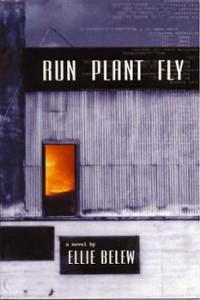
Run Plant Fly

Alright world, I'm back refreshed; ready to continue my life. I went and visited my parents for a week, and am ready to face the world once again. I finished Run, Plant, Fly by Ellie Belew a little while ago, and my reaction is slightly mixed. Set in a little Washington town called Raventon, the perspective of characters change often and the plot is subtle. The copy I read was lent to me by my friend, Holly. I don't know where she got a copy of this book, because it is not well read. However, I appreciated the small world feel the novel left me with. Living in Washington state, the terms of location brought me into the novel's world in a deeper way. (Terms included were "Seattle", "I-90", "the pass", etc.) 

Let me return to the plot of this book though. In a small town, there is nothing going on. Any event is a big event. For those of us who have lived in those tiny places in the world, you can understand the social change that comes with the smallest events. Coming into Raventon is a small tourist attraction called "the Simulator", but with it comes jobs, change, tourists, and something to talk about. The world of these families, children, couples, and individuals centers around this slight change to the world. It wasn't until maybe half way through the story that I began to engage with the story as person, and not a reader. 

Because there's so many characters and perspectives, I had a hard time getting attached to any particular one of them. It made for a slow beginning, however when I did attach and recognize the characters their story was more meaningful. Mostly, I acknowledged the losses of each individual and watched them grow. And in this small, and almost unspoken idea is the book itself. The title seems so distant from the events in the story. These characters are barely moving, and most certainly not running or flying. This sequence of running, planting and flying did not make sense to me--but it comes from the same sequence of pole vaulting. One builds up to the action of flying, but one needs to run with assurance first. After completing the novel, the title fits into place--but again, subtly. 

Even the story itself has a blurred feeling to it. Nothing is bold, and outright. Things are hidden in the shadows, and secrets are kept. One of most important characters, Cuz, has a persona of hiding. She lives to be unseen. Her perspective, also, is the most insightful. The blurriness is a theme, and a motif throughout. I really did feel that the end brought it full circle however. Although this book did not bring me to tears, or complete me--I appreciate it. 

happy with the small published books of the world,
Emily

Monday, September 15, 2014

Treasure Island

Oh boy. This story has a much different pace from the last few books I've read, and I'm glad. Treasure Island by Robert Louis Stevenson has been on my reading list for, literally, years. This book was the last book my eighth grade English teacher, Mr. Hayward, had us read. We read it out loud in class, and worked our way through the pirate slang and slightly older English terms, and spelling. However, the school year ended before the book did. I was determined, as a 14 year old, to finish the book. Butttt, then I moved and was meeting new people in a new place, and it got put aside. It wasn't until I saw this perfect copy at Goodwill two weeks ago that I knew it was time.

For the last eight years I have periodically wondered--what happened to the pirate mutiny? Did they make it out alive? You see, I've been under the impression for past eight years that they all died. Not to give anything away, but it doesn't quite end like that. 

Originally published in 1883, Stevenson starts our story at the Admiral Benbow Inn with young boy Jim Hawkins (the MC). Through a series of rather unpredictable events, he becomes the owner of a famous treasure map in the pirate community and is sent off to find it. There is a continuous tension of mutiny, attack and loyalty on board the ship at sea, especially with the one legged pirate: Long John Silver. I think that one of the reasons this book works so well, in terms of plot and conflict, is the existence of this single character. Hired on as the cook of the ship, Silver is the continuous threat. Never knowing where his loyalty lies, he is the embodiment of the tension between two groups. Honestly, his existence is what makes the read worth while. Hawkins is out main point of view, but that does not mean that I love him. He's young, he makes mistakes, and always seems to have luck on his side. I feel that the story is truly centered around the one-legged pirate and what he will do next.

Oh, and make a note if you plan to read this work of art, that the language will be challenging in areas. I did get lost a few times, and did not understand every detail about working the ship. Did I understand the overall scheme of the story? Yes. Do I understand what a luff is? No. But I do what I can.

Other than that, did you know that young Christian Bale, as known for his film role of Batman, played Jim Hawkins in the 1992 version of Treasure Island

In the making of a terrible pirate,
Emily

Sunday, September 14, 2014

A Separate Peace

 I started A Separate Peace by John Knowles in March of this year, and for a 200pg. book it took me a long time to finish. I just did not get into it. My older sister, Hannah, recommended it to me and said she finished it in one sitting in only a few short hours. I, on the other hand, read 72 pages and quit for months. The pace of the book is slow, which is fine. But the story did not grab me by the horns and say "LOOK AT ME. I AM STORY". However touching the story may be, there was a monotone rhythm throughout. 

The story is set at a private boys school during WWII, that is seemingly unaffected in the beginning. Our main boys: Finny and Gene (Gene being our 1st person narrative), are partaking in summer classes at the meager age of 17. Throughout the work, there is a growing tension of the draft, enlisting, school being closed down, and surprisingly the topic of the 1944 Olympics. Finny and Gene are in the graduating class of 1943, in the middle of the war, and must take strides to accept their fates. 


What my personal issue with this work is not the story, the plot is touching and irrevocably intense in spots. I had an issue with Gene. I don't relate to him, and I can tell you right off the bat: it's personality. Gene arrives on time, and early; I am always late. Gene is predictable and safe; I like spontaneity and adventure. Gene would rather stay in and study on a sunny day; obviously, I would choose otherwise. He is a much different character than myself, and much different from Finny which is the driving force throughout the plot.

About two thirds through the novel, the story takes a darker turn and continues this path steadily until the climatic end. Warning: this is not a happy story, nor was it ever intended to be. I also was not expecting the end. Maybe I wasn't thinking, or maybe this happens to most people. Either way, I walked away feeling jostled? You don't want things to end the way they do.

I find the title in perfect correspondence to the end of the book, as well. So if you can find any hope in that, dear reader. I'm off to bed.

Onto a separate piece of literature,
Emily

Tuesday, September 9, 2014

Krakatoa: The Day the World Exploded


Well, I can say with confidence that my book reading is almost always spontaneous. I bought this at Goodwill during their semi-annual book sale; because I had just taken my Asian Geography class at Central Washington University, and was interested in learning more. That class had to be one of the best classes I've ever taken, and I don't even like geography. Needless to say, we had mentioned the volcanic eruption of Krakatoa, but not gone in depth. And when you can buy education for $1, you don't say no. 

Still, I don't know what I was thinking about this book, Krakatoa: the Day the World Exploded, before I read it. Simon Winchester, the author, was a geologist at Oxford. Let me say that again: Oxford. It's not a fun book with a plot. No, this is researched work--basically the entirety of Winchester's education. He spent a complete chapter over the history of plate tectonics, which is important to geologists. I am not a geologist, and I happened to think that geology is one of the most uninteresting topics in the universe. So if I were to read this again, I would skip over chapter three: "Close Encounters on the Wallace Line". 


So with that in mind, reading this is for the purposes of learning. Let me debrief the main points. The volcanic eruption of Krakatoa, located in between the two most important islands of Indonesia, was the loudest sound recorded in human history. It was heard in parts of Africa, India, all over Asia, Australia and the Pacific. It is the largest volcanic eruption in modern human history, (don't even think about comparing it to Mt. St. Helens). Near 40,000 people died, and primarily drowned because of the tsunamis caused by the eruption. Krakatoa exploded to such a large extent that the volcano no longer to exists. That's right, the island blew it's self up. THE ISLAND BLEW ITSELF UP. Or at least into several different islands. But as far as the volcano is concerned, yeah it's gone. 
The island that used to be Krakatoa is now three
different islands, and Anak Krakatoa is new.
Anak means child in Malay, making the name
mean the child of Krakatoa. 

What is surprising about reading this research though, is how it had affected the world. I had never heard of Krakatoa before college, and still would never consider the event famous. It's been less than 150 years, and this phreatomagmatic explosion is never spoken of. Sound waves of the explosion traveled around the earth seven times. Mt. St. Helens blew off her top, but the volcano is still there. Can you even imagine the consequences if the mountain you live by, underneath, around just spontaneously combusted? It's like the earth had a giant zit, and had so much pressure building up that it had to pop itself. 


I can't even begin to think of the realities of having a volcanic explosion to the extent of Krakatoa. Yet, here I live at the base of Mt. Rainer everyday. Maybe now, I'll be more educated on the signs of an about to explode volcano.

So I'll know when the world ends,
Emily


Thursday, August 21, 2014

Mirror Mirror

Famous for his work titled Wicked: The Life and Times of the Wicked Witch of the West, Gregory Maguire has taken multiple fairytales and reinterprets them. This work titled Mirror, Mirror is Maguire's version of Snow White. The story is placed in the very early 1500's Spain with references to the historical context of the Crusades, especially the Pope. With a more concrete background, there comes both pros and cons. This time period is not my favorite or am I very well educated on it, however it is just background so it's not overwhelmingly necessary to know. I do think that I would have had more satisfaction if I was educated on the political culture of the time. No matter, Snow White (called Bianca) travels from childhood to adulthood in 276 pages.


Maguire.
There are multiple gaps of time as Bianca is depicted as a young child, 11, 16, and, possibly, 18. These time gaps are correlated with changes of perspective in characters. I normally, really enjoy the change of perspective (as seen in The Game of Thrones) but in this shorter novel, I did not feel especially connected to anyone of them. It went to the 'evil step-mother' figure, to the 'huntsman', the father, Bianca, and the 'dwarfs'. The novel as a whole was written very ambiguously. There were multiple points were I felt like I had missed a piece of information. Maguire is talented, I would not say otherwise; but this is the second book I've read of his (Confessions of an Ugly Step-Sister) and I haven't loved either one. I do intend to read Wicked at some point, but if it follows the same writing style as both of these: I don't have very high expectations.  

He, Maguire, most certainly did take a new perspective on the familiar Snow White, but I finished the novel without caring about Bianca. The story's center, and I don't know that I loved her. She's supposed to be my heroine, and I did not get to know her very well. She was there, and alive (part of the time), but she did not do very much. I mean, if she wasn't sleeping or being dead, she was a child. Most of her story is what happens to her, and not what she does. Maybe this is just the nature of Snow White themed stories, and that is not Maguire's fault. I do appreciate the storyline he added for Bianca's father, and wished that there was more emphasis or follow up with him. Not to mention that THE KISS--the mysterious man who would wake our Bianca--was just stapled in there. I do not feel one way or another about it, however it was better than the other optional male (whom I will not say). 


I love fairytales, and since Snow White was my grandmother's favorite--I have a special attachment to it. One thing I must compliment Maguire on is his description of the evil stepmother figure: she's blonde. That's right ladies in gentlemen, the dark and twisted character is represented with light colors. For whatever reason Maguire choose to do this, I appreciate it. Since western culture associates black and blonde to immediate stereotypes, there is a certain innovation to stray from generics.

Reminded of my grandma, 
Emily


Sunday, August 17, 2014

Game of Thrones

I have finally gotten into Game of Thrones this last six months. I had watched the first six episodes of the TV series, and had liked it but did not understand the appeal until this 800 page written version. Written by George R.R. Martin, I can not begin to emphasize how well written this series is. Let me emphasize: I watched only six episodes of the first season of Game of Thrones, and each episode was roughly equivalent to 100 pp. of text. The information that was expressed in the novel made the tv series less informational. 

TV GoT (Game of Thrones) was good, do not get me wrong. Watching the show had allowed me to understand what the premiss of the story was, introduce all the major characters, and give me a feel for the events to come. However, the show did not make as much as chronological sense as the book did. The fact that 100 pages was summed up in 40 minutes of film alone shows that the written word had more information, most of which is inexpressible physically. For example, Catelyn Stark's motivations, and choices are more clear through her thought process. Even the importance of the Winterfell's catchphrase "winter is coming" has more meaning, or at least the meaning was more clear. I think that I could watch the show now and have a more complete sense of what is actually happening.  
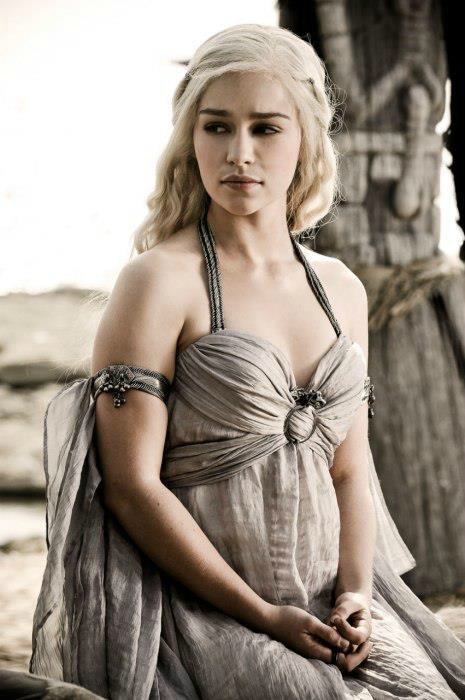
Daenerys, the blood of the dragon.

I haven't even mentioned how competent and strong the female characters are. How often do we find a fantasy saga were females are slightly leading males? Of course, who really has power in this book is debatable, but it is undeniable that Arya, Dany, Catelyn, Cersei, and even Sansa are strong. I didn't even like Sansa for the first 700 pages. In her last chapter in the book, her strength finally showed through. I am excited to see how she develops--I find her situation at the end of the book the most interesting.

Last thing: the book ends in a very similar fashion to The Grapes of Wrath. [*hint,hint*]

Nerd, Fan or Bandwagon?
Emily