Sunday, June 22, 2014

EmiTown

 This was the first book I bought, post-graduating college, and its full of pictures. I have never been more proud of myself, and could not think of any more fitting image of how college wrecks the soul. I mean, I graduate and buy a 400pg. comic on the simplistic life of yet another dreamer barely making it. Called EmiTown by Emi Lenox, I bought this book on a whim. It felt right in my hands, and it had been way to long since I had bought anything from our (amazing!) local comic shop. I could go on about Central City Comics forever, but this isn't about that.

EmiTown is a sketch diary, as seen on cover, which was different than any other comics I have read. Reading a story that was true, and simple in plot--changes the feel of it all. I mean, why read a 400pg. work on a story where nothing significant happens? [Actually a lot happens in her life, but most pages are mundane topics]. Why am I so wrapped up in a story where breakfast burritos and coffee are talked about more than major life events? And why does life seemed to be more clearly talked about in breakfast burritos and coffee? Some of the spreads are like looking directly at life in the face, and accepting that I will probably never do anything great. Life is more in the simple joys and pains than anything else. Example A: In EmiTown (Volume 1) she signs a publishing deal for the book I am reading (weird, right?), but the story actually doesn't reach some climatic end because of this. The story keeps moving, slowly, painfully, and happily. It's a diary, and it is simple in nature. Very realistic and relatable. 


One of the downsides to this being a public diary is not all the information is given out in details. Example B: we know as an audience, that Emi is going through love troubles, but there is no names, or details. In any another fictional piece, and even non-fiction there is a name, clearly defined roles, and reasons for why things did not work out. She doesn't do this. She has herself as various characters that represent different aspects to her love life: White Heart, Black Heart, Ocean Girl and Army Cats. So sometimes I felt like I wasn't following the story as accurately as I could be. Another strange thing is that this book takes place 2009/2010 (the year I graduated high school) so a lot of the references are things I forgot were such a big deal (like the movie 2012, or Justin Beiber's song "Baby"). 

But seriously, Emi Lenox has got herself a new fan (I LOVE THE ART WORK). I think my biggest reason to love this sketch diary is that my best friend has a very similar style of comicking. Reading this book is like having a piece of my best friend with me all the time (who is in July moving to Taiwan for a whole year! Sad face:{ ). Besides personality differences, the art is familiar to me, and I love it. 

Check her out @ Emi Lenox's Blogger Site:) 

Comics for Daysssss!
Emily

Wednesday, May 28, 2014

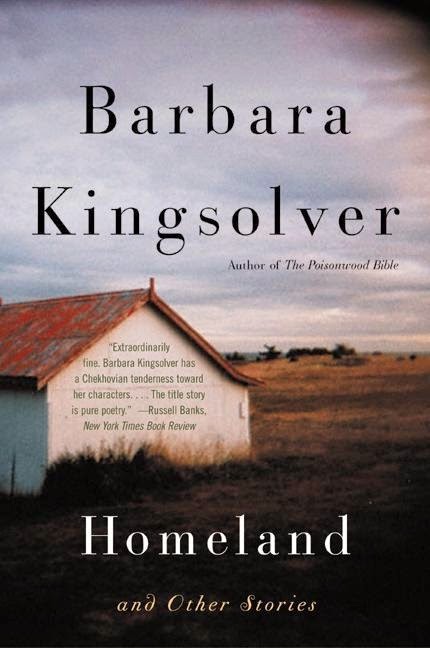
Homeland and Other Stories

Barbara Kingsolver is my absolute favorite author. This collection of short stories titled: Homeland and Other Stories is one of her earliest work. Actually, the author's works list had only two novels in the edition that I read. Another note, before I work on my review, this is my 8th Barbara Kingsolver work (more like 8 1/2) out of 14 total works: including essays, novels, short stories, and prequels. Because of this, I'm probably bias on my opinion of her works.
Barbara Kingsolver in her
younger years.

Unless a short story is famous, or about sci-fi; I don't think I've read any for fun. Short stories as a genre are not enough time for me to reach a deep connection with the characters. With that in mind: this wasn't my favorite work. It is not because of the lack of author's talent, but just a personal preference. Although Homeland is Kingsolver's only series of shorts. I think her artistic preference is in novels and character development, such as The Poisonwood Bible and The Bean Trees. It's also difficult to review a series of small stories--I'm not individually looking at each story.

One of the things that Homeland did for me though was open my eyes to others' experiences. A couple of her stories made me stop and a put the book down. 

Always a fan,

Emily&Jeoffry the Cat


Thursday, May 22, 2014

The Thief

This series, The Queen's Thief, was recommended to me by my older sister Hannah. It was her favorite series when she was in early high school. With that in mind, the story is written for a younger audience. But this doesn't take away from the story's content which is incredibly intriguing. 

The first book in the series, The Thief, starts off with Gen stuck in the King of Sounis' prison. Renowned for his abilities for thievery, the King's scholar, the Magnus, forces Gen to follow them on a journey to find a mythical item. 


Instead of the traditional fantasy time-line, this book has a very slow beginning. The majority of the story is background foundation and traveling. Mentally, I was waiting for the story to begin as far as action is concerned. Until chapter eight, the plot is relatively flat. Besides of the occasional skirmish, the story is hanging over stealing this mythical item. Even though the story has a slow beginning, the end makes the waiting worth it. In the last ten pages, the story reveals information that changes the story from the very beginning. Without a doubt, I only want to read the next books in the series because of these last pages. It would feel incomplete to not finish this story in its entirety. Not to mention that the series is still in the process of being written. Who doesn't love that?


One of the benefits of these books, is the fandom is really small. They are not well known, but that makes the author's relationship with her fans really intimate. According to Hannah, my sister, the author: Megan Whalen Turner has been known to get lunch or coffee with her fans if she's in the area. It something I'm interested in looking into. 

Becoming a new fan,

Emily


Monday, March 31, 2014

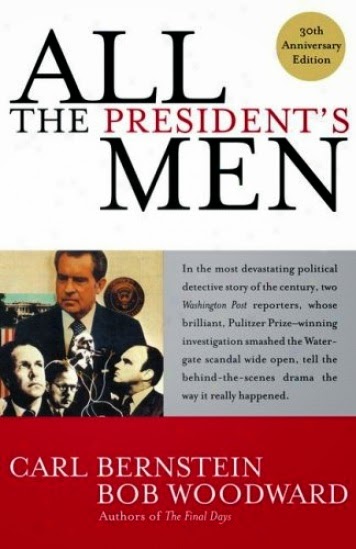
All the President's Men

First, I'm sorry to have read two literary journalistic works back to back. They're usually more dense, and heavy material. I was assigned All the President's Men for my POSC 101 (Political Science 101) class this past quarter, and just finished it this spring break. It was an unintentional coincidence.

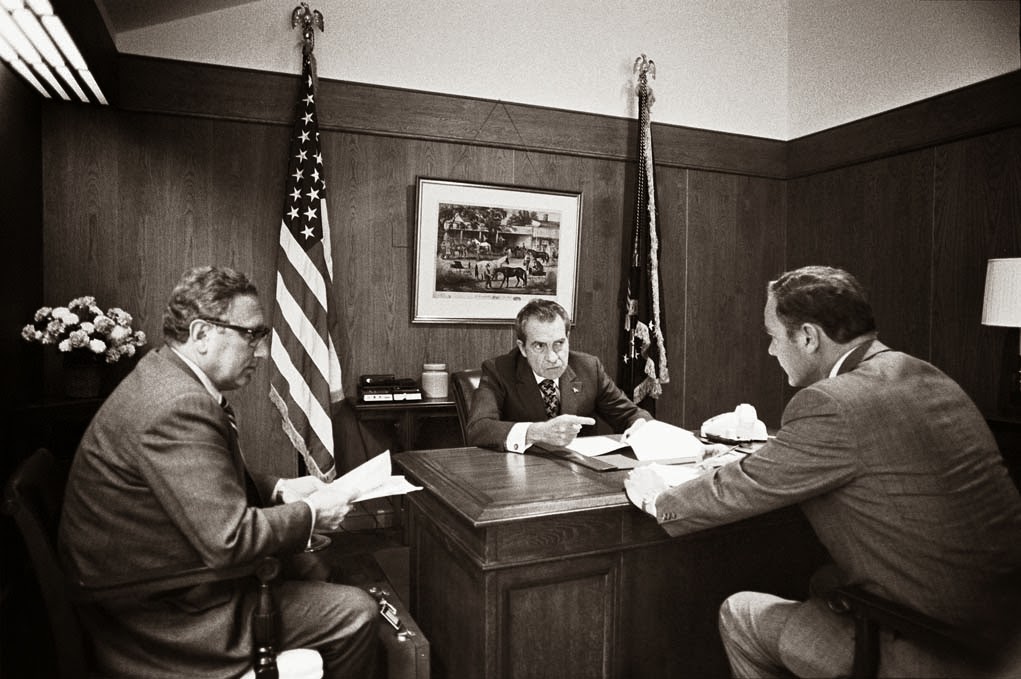
All the President's Men, as I said, is a journalistic work done by Carl Bernstein and Bob Woodward. It is the complete story of uncovering the Watergate scandal, and the Nixon administration by the two authors, or reporters for the Washington Post. To be honest, I had very little background information on Watergate. Before reading this, I associated Nixon with some sort of illegal activities. Something like listening to tapes, wiretapping. I wasn't actually sure, but it was 'apparently' a big deal. I was so uninformed of the complete immensity dealing with Watergate. It is difficult for me to look at All the President's Men as historical truth. Shocking facts about the abuse of government, the lack of respect for the press and civil servants, and the nature of the Nixon Administration was unexpected. I, now, understand the natural lack of trust between the people and government. I understand why people say that politicians only want power. Unfortunate, but true All the President's Men opened my eyes to internal political turmoil. 
Bernstein, left, and Woodward in the Post's news room
during the course of the Watergate scandal.

Bernstein and Woodward were an unexpected team, and had no idea what they had gotten themselves into on June 17, 1972. The Watergate Hotel staff found five men burgling the Democratic Headquarters room with bugging equipment. That is it. This is what undermines a White House Administration, a president, and unspoken organization of political power. It is over a year of non-denial denials, secret sources, and vague hints a vast array of people that Watergate is turned into the downfall of President Richard Nixon. 

Because of this, and all of the information in the book, it was difficult to follow. At times I had to google a name, just to clarify his, or her, role in the story. There is a plethora of names involved, and some are not as important as others. Following the trail of one clue to the next is what moves the scandal along. It is dense, and thick. But all of the information is important. I am so grateful to have read this, but it was challenging. I would not be able to read this in a sitting. However, the descriptions of visible emotion of various actors was incredible. Understanding the emotional state of the President's men, the civil and innocent servants, and the press was easy. The authors made the realities of the situation very clear. I will most certainly be thinking about this book for a long time.

I have been told that there is a film, and I'm curious to watch it. I have a feeling that the story of Watergate might be easier to follow in film. Each name has a face, and each face's actions are seen. I look forward to watching it.

Inspired to be a reporter,
Emily

Friday, March 28, 2014

The Spirit Catches You and You Fall Down

This work is absolutely brilliant. I have nothing but good words to say about The Spirit Catches You and You Fall Down by Anne Fadiman. However, I would not expect this reaction from most people. This is a non-fiction work of literary journalism. When I picked out of my pile of books to read, I had no idea what I had gotten myself into. I feel that it is impossible to give the book justice. 
Above:Anne Fadiman, the author of
this book. In 1997, her work was
given the National Book Critics
Circle Award.

The Spirit Catches You is a work exploring the culture of the Hmong people, the majority living in Laos and southern China, and the intercultural communication of the Hmong and Americans. One of the reasons why I am so pleased with this novel is it has absolute pertinence to my undergraduate degree. I just last week finished a classes on intercultural communication and Chinese religion. This book explores both of these topics. Now, the Hmong is not Chinese, but the religion of the Hmong shares similarities with Taoism [or Daoism]. Reading this journalistic work makes me feel more rounded in my education. With this as a background, I do not expect others to share the same enthusiasm for the topics presented here.

Lia Lee, and her family, is the central character of this anthropologic study. From a very young age Lia Lee has epilepsy.  Her parents, who speak Hmong and no English, have to communicate with American doctors. The conflicts and the lack of understanding ultimately ruin Lia Lee's chances of a "normal" (according to American standards) life. Fadiman fully explores the communication issues on both sides, and exposes the frustrations of doctors and the family. Coming from an American culture, it is difficult to see how other cultures perceive our behaviors. While reading this book, it constantly goes back to American culture is just as confusing as Hmong. A culture only makes sense to those who are apart of it. American medicine is purely logical, while Hmong medicine is based out of spirituality. Lia Lee's family blames the American doctors for ruining their child, for overdosing her, for stealing her from them. On the other hand, the American doctors are frustrated that Lia's parents do not give her the correct amount of medicine, are not following through with prescriptions, and ultimately failing thier daughter.

What makes this work so good is that Fadiman goes alternates between Laotian history and the Lee's current situation. All the information about the Hmong culture is given to the audience, and then put into a real example. If southeast Asia is an area of interest, I highly suggest this valuable and informative journalism. 

Feeling educated,
Emily

Wednesday, March 26, 2014

Looking For Alaska

John Green's works are incredibly popular right now. I feel like I see them and references to them everywhere. So much to the insistence to one of my best friends, and a spiked curiosity I read Looking for Alaska. I will attempt to stay away from spoilers, while giving my best opinion of the novel. 


This is my favorite "cover" of the novel.
I do,unabashedly, judge books by their 
covers. The artwork was done by hipsterowls
on deviantart.com.

It has been a few days since I finished the story, and I have walked away with a sense of neutrality. To be fair, I do not normally read this young adult/teenage novel genre. I find it, most of the time, immature or uninteresting. There are things that I liked, and things that were predictable. I do not expect to read this again, but I would read another one of his books. 

The character development of the main protagonist: Pudge/Miles, is amazing. To see this young high school student go from a wallflower to an assertive individual felt natural. In my opinion, these types of transformations can be difficult, or feel forced. However in Pudge's case, he transformed to fit his new surroundings. He went out "to search for a great perhaps". This quote follows him throughout, and he does exactly that. His character is dependent on seeking, learning, experiencing, finding answers, and developing. Even though his world is dependent on the people around him, especially heart-throb, wild girl Alaska, he is the person that is moving forward. He is the one who grows. I understand the appeal and the emotional connection he creates with the audience. 

However, the reason this book was bland to me was the predicability of the entire story. Even from the first chapter, his father tells him "no drugs. no drinking. no cigarettes." Two of these 'no's are broken. It is expected. Especially with Alaska's character, she is so one-dimensional. She is fated [for what I will not say]. Her character is grounded in her past, and she does not develop beyond it. Nor does she have the opportunity to. This is not to say that her character is uninteresting. She is fascinating, brings energy, and life to the story. But she is written to move Pudge's story along. Her own story is predictable, and slows down the rest of the novel. Knowing what is going to happen, or what did happen in regards to her takes away the mystery and the life. 

There is a reason John Green's works are so famous right now. The ideas he brings about life, death, religion, purpose, and hope is appealing. He is interesting, and is very enlightening. I would be lying if I did not at some point stop and think, deeply, about some of his points. However, this post is more about the story, and the not the moral. The story was neutral, the morals are deep, and personal. I feel curious about his other works, and am considering another one. 


unsure about young adult fiction,
Emily

Thursday, March 6, 2014

Those 18 Credits

I don't know how many times I have to remind myself to not start projects before a new quarter starts. I just don't want to read in my spare time because I'm reading a thousand other things. So here is my reminder that I am alive. Good news!

Shout out to those students who are approaching finals week like myself. Woot.

Drowning in ink,
Emily